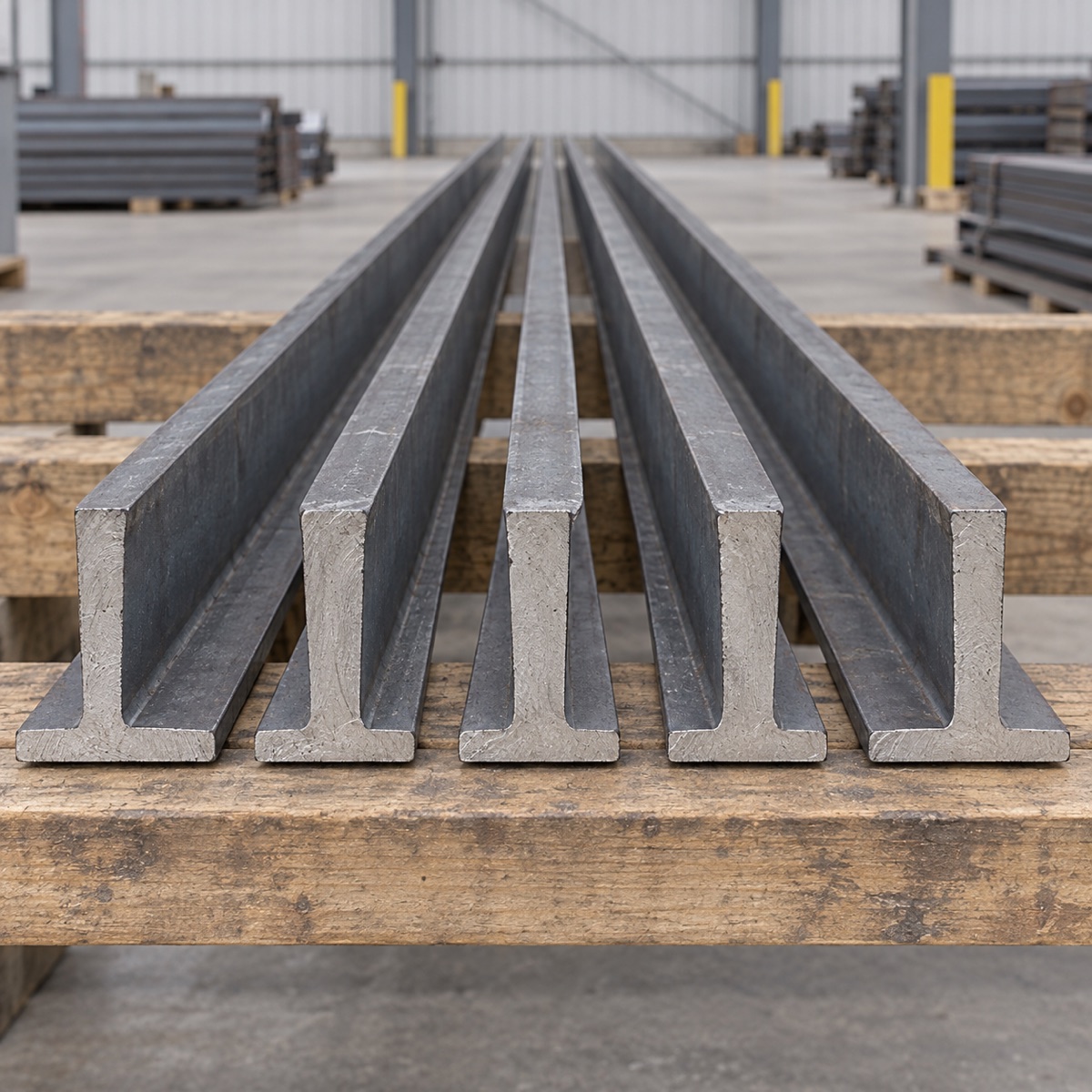
A steel tee is an open profile with one flange and a central stem, producing a T-shaped cross-section. It is distinct from angle steel, which has two legs meeting at a corner. Tee sections are used in support frames, bracing details, doors and windows, roof glazing supports and other fabricated steel assemblies.
The product can be described by its overall height, flange width and material thickness. Rolled tees, formed sections and tees cut from larger beams can have different proportions and mechanical behaviour. For glazing or finish-sensitive fabrication, the visible surface and dimensional fit should be considered alongside the strength requirement.
An enquiry should include the tee dimensions, bar length, grade and intended connection method. Mention any holes, cut ends, coating or surface preparation needed before assembly. The sizes below are selected market examples of equal tees. The carbon-steel analysis is provided as a grade reference and does not apply to stainless-steel or non-ferrous alternatives.
These are reference market dimensions for discussing an enquiry. Confirm the required combination and availability in the quotation.
Technical reference
Analysis
Chemical composition is selected for the intended manufacturing or construction use. Confirm the agreed grade and heat analysis for the order.
Reading the values
≤ Maximum · ≥ Minimum
A dash between two values indicates a range.
Composition profile
Structural steel — chemical analysis
Reference ladle-analysis maxima, mass percentages, for structural sections of nominal thickness up to 40 mm.
Structural steel — chemical analysis
Parameter
Reference value
Unit
Carbon (C)
≤ 0.17
%
Manganese (Mn)
≤ 1.40
%
Phosphorus (P)
≤ 0.040
%
Sulfur (S)
≤ 0.040
%
Nitrogen (N)
≤ 0.012
%
Copper (Cu)
≤ 0.55
%
Carbon equivalent (CEV)
≤ 0.35
%
These tables describe reference composition options. Final chemistry and delivery requirements are confirmed in the quotation and heat-analysis certificate.
02 / Specification guide
Define your requirement.
These are the details to provide, not a fixed offered specification.
Application
Intended use, processing route and required delivery condition.
Chemical composition
Required element ranges and impurity limits.
Dimensions & tolerances
Required dimensions, length or particle sizing and permitted tolerances.
Quality requirements
Relevant mechanical or physical properties and inspection requirements.
Packing & identification
Packing format, bundle or lot identification and handling requirements.
Commercial terms
Quantity, delivery destination and required delivery window.
03 / Documents to request
Make the brief complete.
State which documents and approvals are required. Availability and scope are confirmed for each enquiry.
01
Batch or heat certificate of analysis for the agreed material.
02
Dimensional and relevant physical or mechanical inspection reports.
03
Packing list, lot identification and agreed shipment documents.