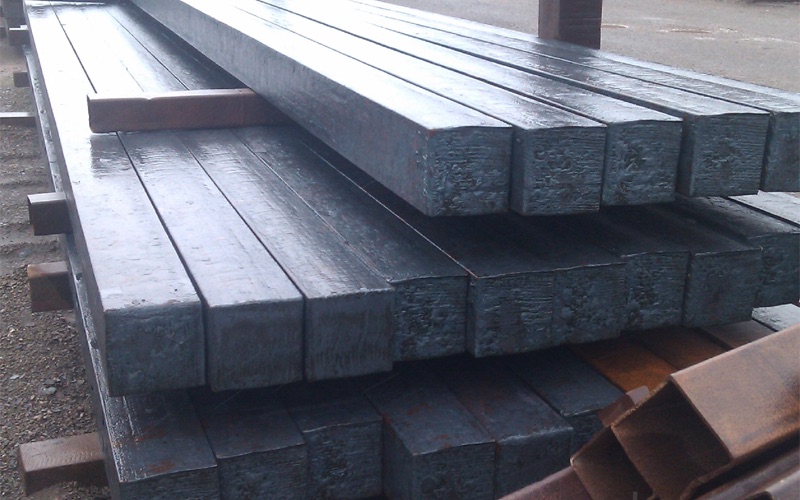
Steel billet is a semi-finished product used as feedstock for rolling long steel products. It is commonly supplied with a square cross-section, while round forms are also used for selected processing routes. Billets are reheated and reduced through rolling passes to produce smaller sections such as reinforcing bar and wire rod.
The two chemical profiles below describe lower- and higher-carbon billet options. Grade selection must follow the intended finished product and mill process, rather than relying on the billet shape alone. Carbon and manganese influence strength and processing behaviour, while phosphorus and sulfur are controlled as part of the agreed chemical composition.
An enquiry should state the section dimensions, cutting length, rolling application and required grade. Surface condition, straightness, corner geometry and heat identification also matter when matching material to a rolling line. The catalogue width below is a dimensional reference; the chemical tables illustrate two grade options and do not represent a particular shipment.
Size guide
Sizes & dimensions
Steel billets — Size guide
Parameter
Size or format
Catalogue width reference
150 mm
Reference square section
150 × 150 mm
Reference length for 150 mm square
3.8–12 m
The 150 mm width is described in the catalogue; the square section and length range are market reference examples. Agree the actual section and cut length for the rolling mill.
Technical reference
Analysis
These are separate reference carbon-steel compositions used for long-product rolling feedstock. The required chemistry follows the final product and rolling route.
Reading the values
≤ Maximum · ≥ Minimum
A dash between two values indicates a range.
Composition profile
Lower-carbon billet — chemical analysis
Reference heat analysis, expressed as mass percentages. Values are grade examples, not the analysis of a supplied batch.
Lower-carbon billet — chemical analysis
Parameter
Reference value
Unit
Carbon (C)
0.14–0.22
%
Silicon (Si)
0.15–0.30
%
Manganese (Mn)
0.40–0.65
%
Phosphorus (P)
≤ 0.040
%
Sulfur (S)
≤ 0.050
%
Composition profile
Higher-carbon billet — chemical analysis
Reference heat analysis, expressed as mass percentages. Values are grade examples, not the analysis of a supplied batch.
Higher-carbon billet — chemical analysis
Parameter
Reference value
Unit
Carbon (C)
0.28–0.37
%
Silicon (Si)
0.15–0.30
%
Manganese (Mn)
0.50–0.80
%
Phosphorus (P)
≤ 0.040
%
Sulfur (S)
≤ 0.050
%
These tables describe reference composition options. Final chemistry and delivery requirements are confirmed in the quotation and heat-analysis certificate.
02 / Specification guide
Define your requirement.
These are the details to provide, not a fixed offered specification.
Application
Intended use, processing route and required delivery condition.
Chemical composition
Required element ranges and impurity limits.
Dimensions & tolerances
Required dimensions, length or particle sizing and permitted tolerances.
Quality requirements
Relevant mechanical or physical properties and inspection requirements.
Packing & identification
Packing format, bundle or lot identification and handling requirements.
Commercial terms
Quantity, delivery destination and required delivery window.
03 / Documents to request
Make the brief complete.
State which documents and approvals are required. Availability and scope are confirmed for each enquiry.
01
Batch or heat certificate of analysis for the agreed material.
02
Dimensional and relevant physical or mechanical inspection reports.
03
Packing list, lot identification and agreed shipment documents.