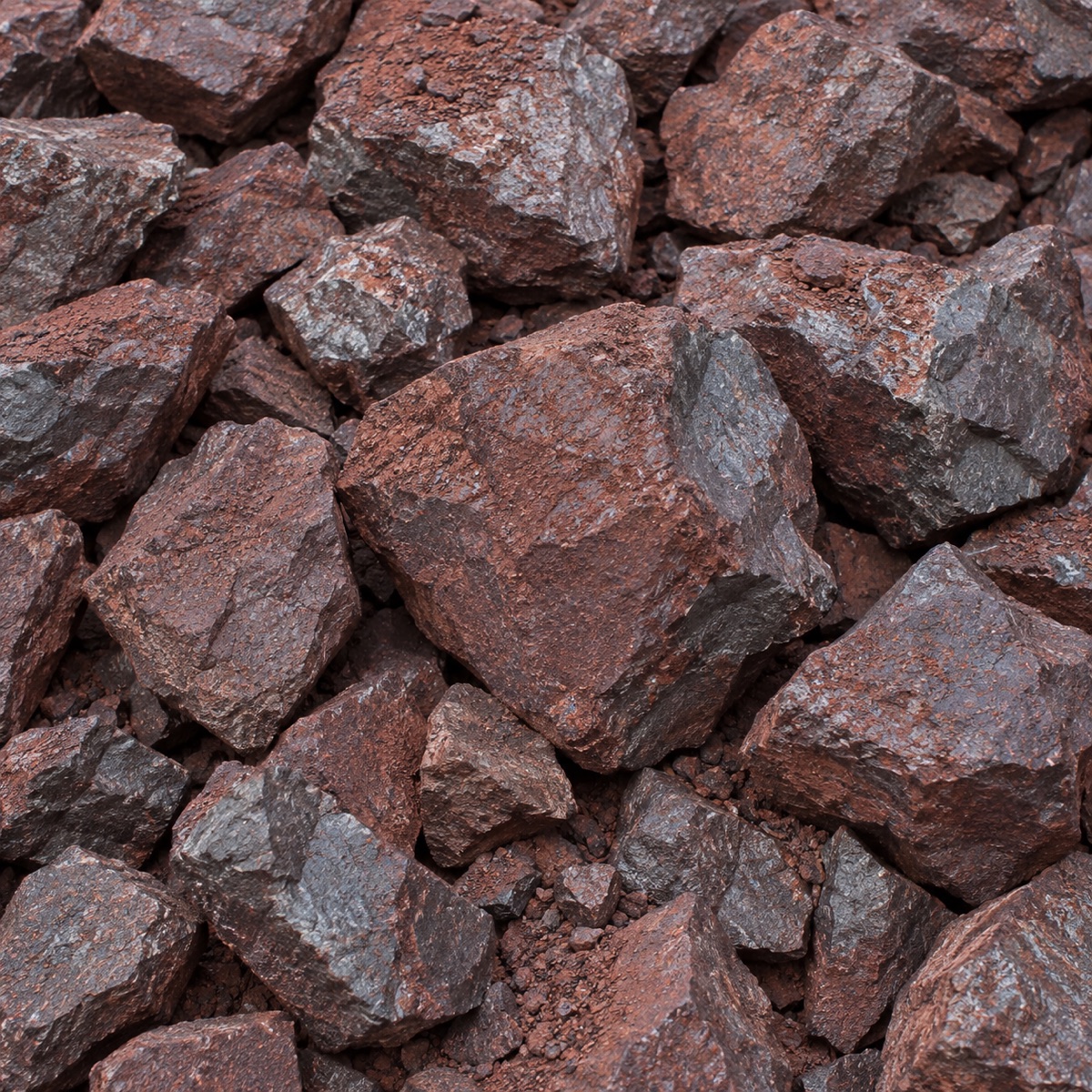
Hematite is an iron oxide mineral with the chemical formula Fe₂O₃. Commercial hematite ore may appear red, brown or steel-grey, depending on its texture and weathering. It is an important raw material for iron and steel production, but the mineral name alone does not establish the grade of a shipment.
Ore is crushed and screened into the fraction required by the receiving plant. Fines may be upgraded or agglomerated, while suitable lump material can be selected for furnace charging. Iron content, silica, alumina, phosphorus, sulphur and moisture should be considered together when comparing cargoes. A laboratory assay is required for the actual material; the theoretical iron content of a pure mineral is not an ore guarantee.
Size guide
Sizes & dimensions
Hematite ore — Size guide
Parameter
Size or format
Fines
0–10 mm
Lump ore
10–30 mm
Delivery form
Screened loose bulk; packing by agreement
These are sizing options for crushed ore. Agree the selected fraction, fines allowance and shipment assay before ordering.
Technical reference
Analysis
Commercial hematite contains gangue as well as iron oxide. This illustrative lump-ore example shows a realistic mineral product rather than the theoretical purity of Fe₂O₃.
Reading the values
≤ Maximum · ≥ Minimum
A dash between two values indicates a range.
Composition profile
Hematite lump — illustrative analysis
Illustrative chemical percentages for hematite lump ore. This is a reference example, not a current sales specification or shipment analysis.
Hematite lump — illustrative analysis
Parameter
Reference value
Unit
Iron (Fe)
64.7
%
Silica (SiO₂)
4.15
%
Alumina (Al₂O₃)
1.60
%
Manganese (Mn)
0.06
%
Phosphorus (P)
0.054
%
Sulphur (S)
0.007
%
These tables describe reference composition options. Final chemistry and delivery requirements are confirmed in the quotation and heat-analysis certificate.
02 / Specification guide
Define your requirement.
These are the details to provide, not a fixed offered specification.
Application
Intended use, processing route and required delivery condition.
Chemical composition
Required element ranges and impurity limits.
Dimensions & tolerances
Required dimensions, length or particle sizing and permitted tolerances.
Quality requirements
Relevant mechanical or physical properties and inspection requirements.
Packing & identification
Packing format, bundle or lot identification and handling requirements.
Commercial terms
Quantity, delivery destination and required delivery window.
03 / Documents to request
Make the brief complete.
State which documents and approvals are required. Availability and scope are confirmed for each enquiry.
01
Batch or heat certificate of analysis for the agreed material.
02
Dimensional and relevant physical or mechanical inspection reports.
03
Packing list, lot identification and agreed shipment documents.