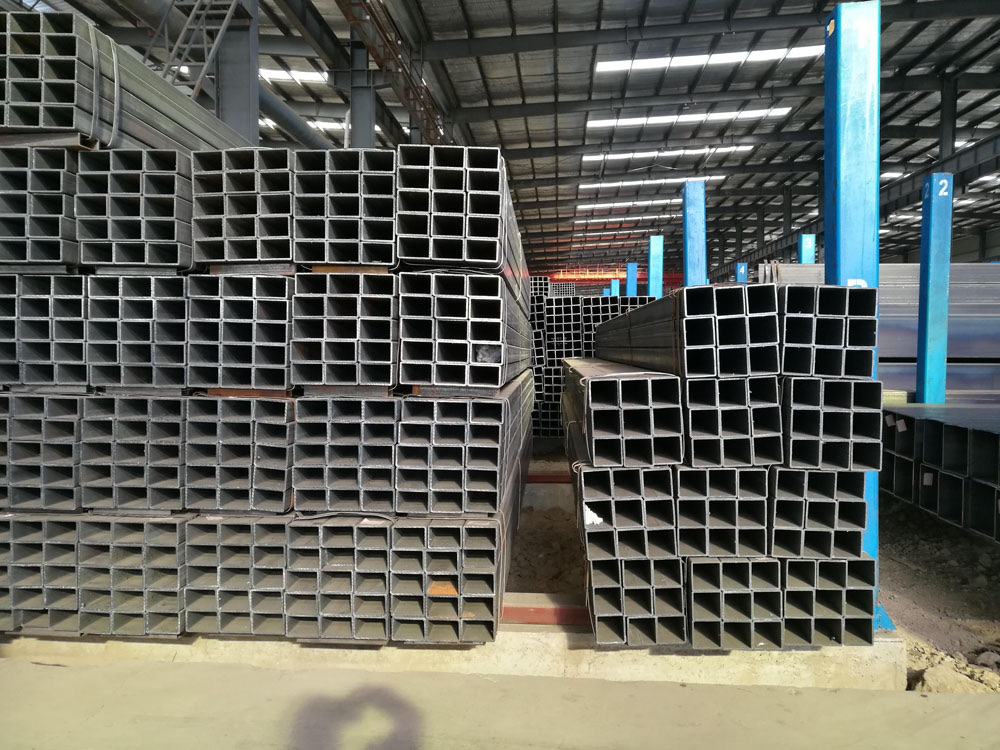
Industrial hollow sections are selected for fabricated structures in which stiffness, connection space and repeatable section geometry are important. Square and rectangular box sections offer flat faces for attachments and a closed form that can resist bending and torsion when correctly designed. Their wall thickness and steel grade distinguish a structural industrial product from lighter furniture tubing.
Applications include equipment frames, machinery supports, industrial platforms, sign structures and large fabricated assemblies. The shape does not eliminate the need for corrosion protection: coating, drainage and sealing details should match the operating environment. Section selection also considers local wall buckling, weld access and how the applied loads enter the member.
The sizes below are a reference structural hollow-section family to help define an enquiry. Specify the exact width, depth, wall thickness, length and grade for the fabrication. The displayed analysis represents one material option and should be matched to the order requirements.
Size guide
Sizes & dimensions
Industrial Hollow Sections — Size guide
Parameter
Size or format
Reference square sections
40 × 40 to 300 × 300 mm
Reference rectangular sections
50 × 30 to 400 × 200 mm
Reference wall thickness
2.0–12.5 mm
Reference lengths
6 / 12 m
These are reference family limits, not a promise that all dimensions and thicknesses can be combined. Larger sections and heavier walls are assessed against the project enquiry.
Technical reference
Analysis
Low-carbon steel is a reference option for structural industrial hollow sections. Its chemistry is considered alongside mechanical properties and section dimensions.
Reading the values
≤ Maximum · ≥ Minimum
A dash between two values indicates a range.
Composition profile
Hollow sections — chemical analysis
A published low-carbon hollow-section composition, percentage by mass. Silicon is a range; the other entries are maxima.
Hollow sections — chemical analysis
Parameter
Reference value
Unit
Carbon (C)
≤ 0.16
%
Silicon (Si)
0.15–0.25
%
Manganese (Mn)
≤ 1.60
%
Phosphorus (P)
≤ 0.020
%
Sulfur (S)
≤ 0.012
%
These tables describe reference composition options. Final chemistry and delivery requirements are confirmed in the quotation and heat-analysis certificate.
02 / Specification guide
Define your requirement.
These are the details to provide, not a fixed offered specification.
Application
Intended use, processing route and required delivery condition.
Chemical composition
Required element ranges and impurity limits.
Dimensions & tolerances
Required dimensions, length or particle sizing and permitted tolerances.
Quality requirements
Relevant mechanical or physical properties and inspection requirements.
Packing & identification
Packing format, bundle or lot identification and handling requirements.
Commercial terms
Quantity, delivery destination and required delivery window.
03 / Documents to request
Make the brief complete.
State which documents and approvals are required. Availability and scope are confirmed for each enquiry.
01
Batch or heat certificate of analysis for the agreed material.
02
Dimensional and relevant physical or mechanical inspection reports.
03
Packing list, lot identification and agreed shipment documents.